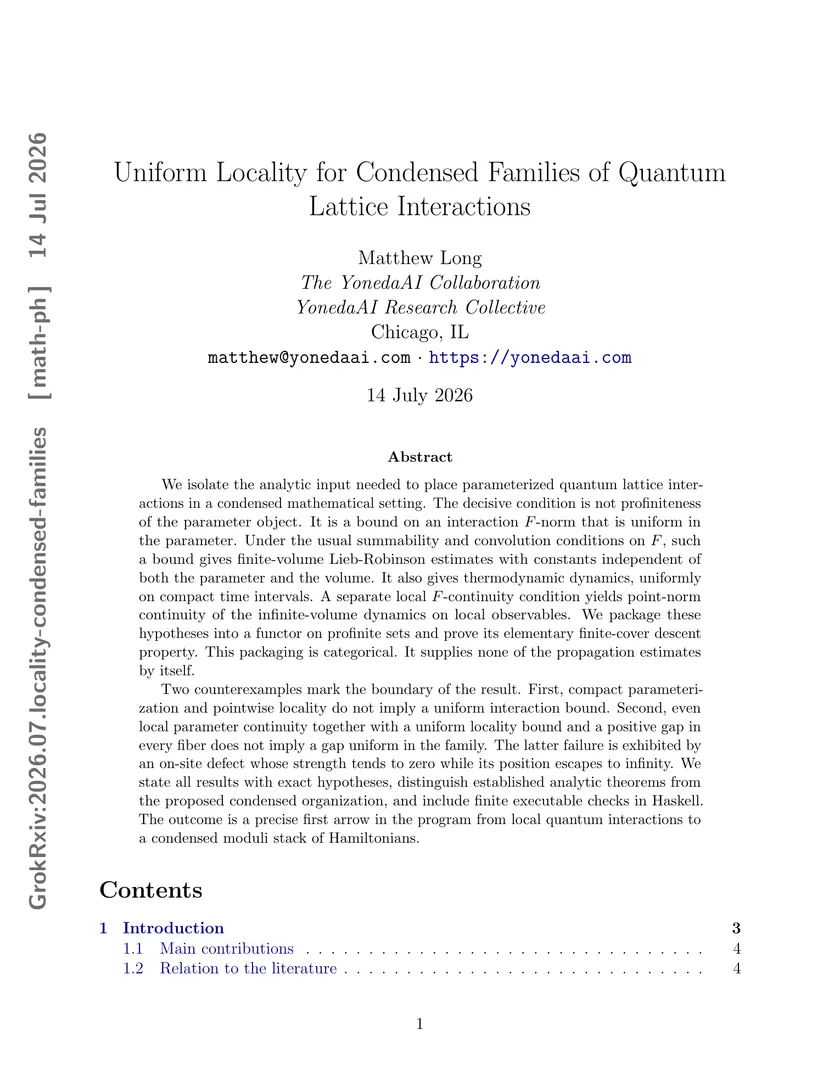
ESTABLISHED
Uniform locality
The analytic first arrow
Uniform interaction norms, not profiniteness, give parameter-independent Lieb-Robinson bounds. Thermodynamic dynamics also require a uniform vanishing tail.
Condensed mathematics × quantum matter
A six-paper research program tracks the exact obligations between local Hamiltonians, uniform gaps, stabilized phases, and an invertible condensed phase spectrum.
The five-stage program
The coral notch marks the gapless transition locus. It is a boundary to analyze, not a categorical shortcut.
The arrows define the research program. They are not assertions of equivalence.
Claim-status ledger
Conditions stay in the scope column. Epistemic labels use the corpus-wide vocabulary exactly.
Five papers + synthesis
Read each paper as HTML, open the canonical PDF, and inspect its matching executable and formal artifacts.
The analytic first arrow
Uniform interaction norms, not profiniteness, give parameter-independent Lieb-Robinson bounds. Thermodynamic dynamics also require a uniform vanishing tail.
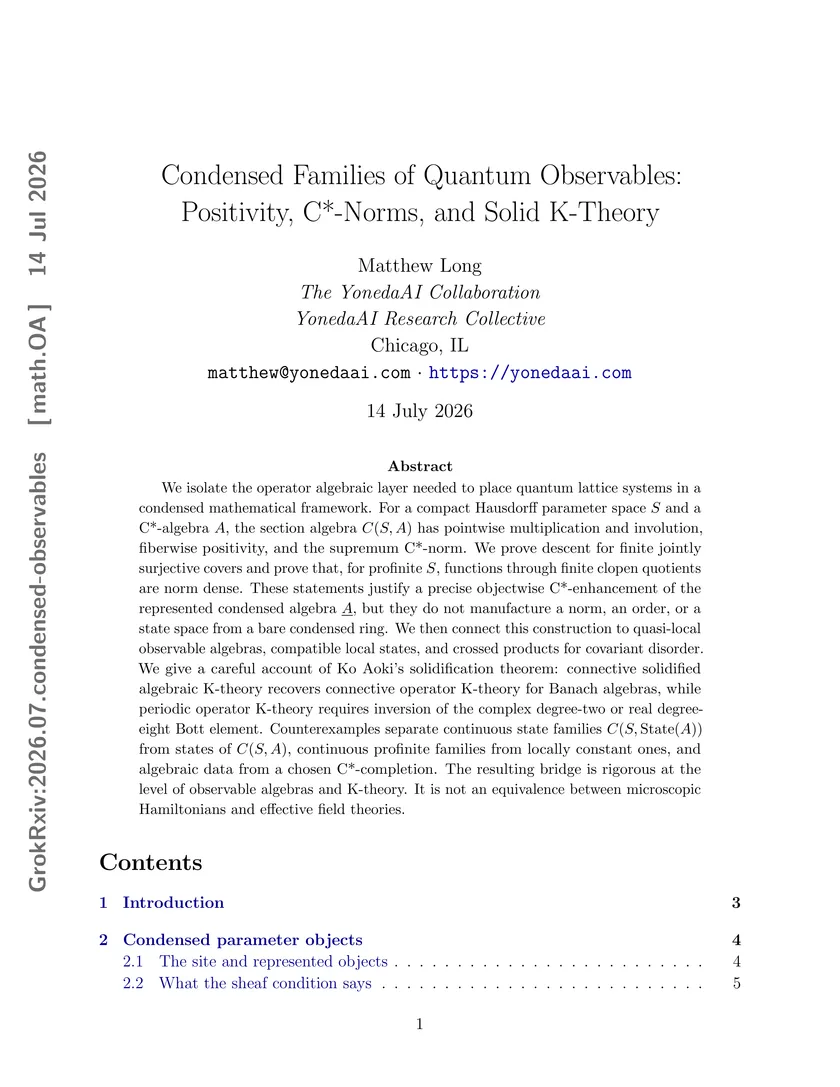
Positivity, C*-norms, and descent
Section algebras preserve fiberwise positivity and the supremum C*-norm while separating analytic structure from bare condensed algebra.
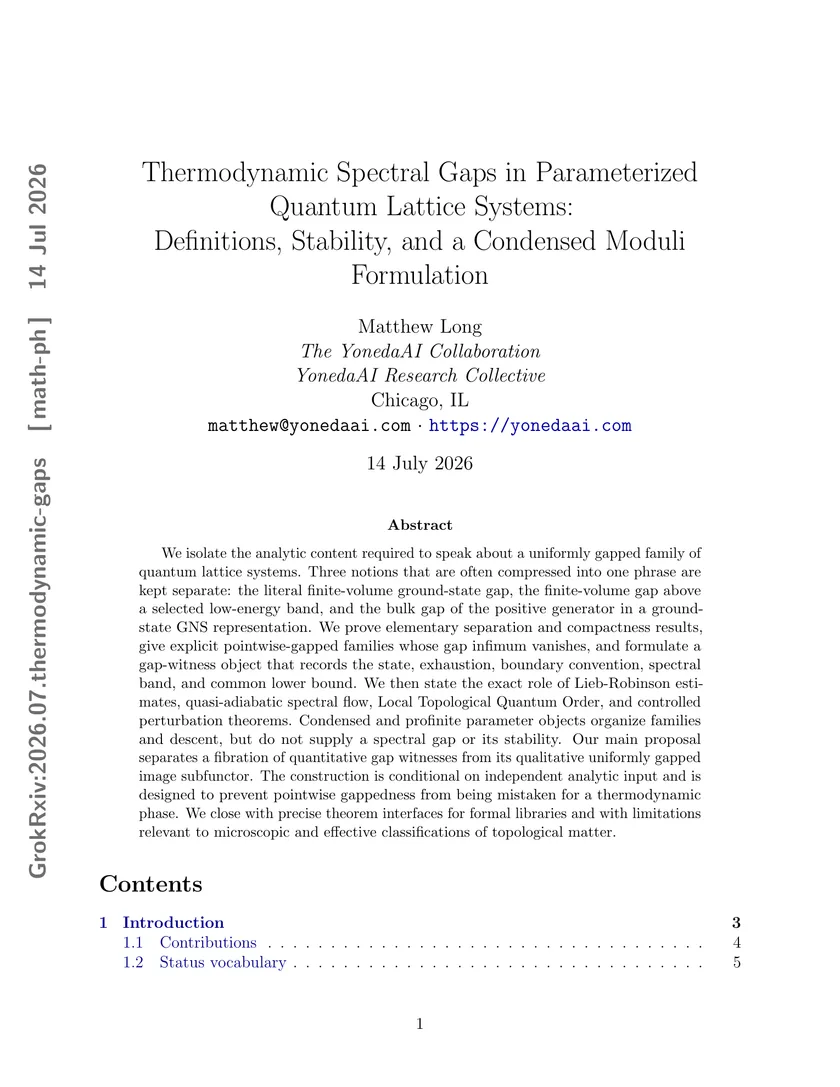
Witnesses, images, and stability
A quantitative gap witness is data; the qualitative uniformly gapped locus is its propositional image, conditional on analytic input.
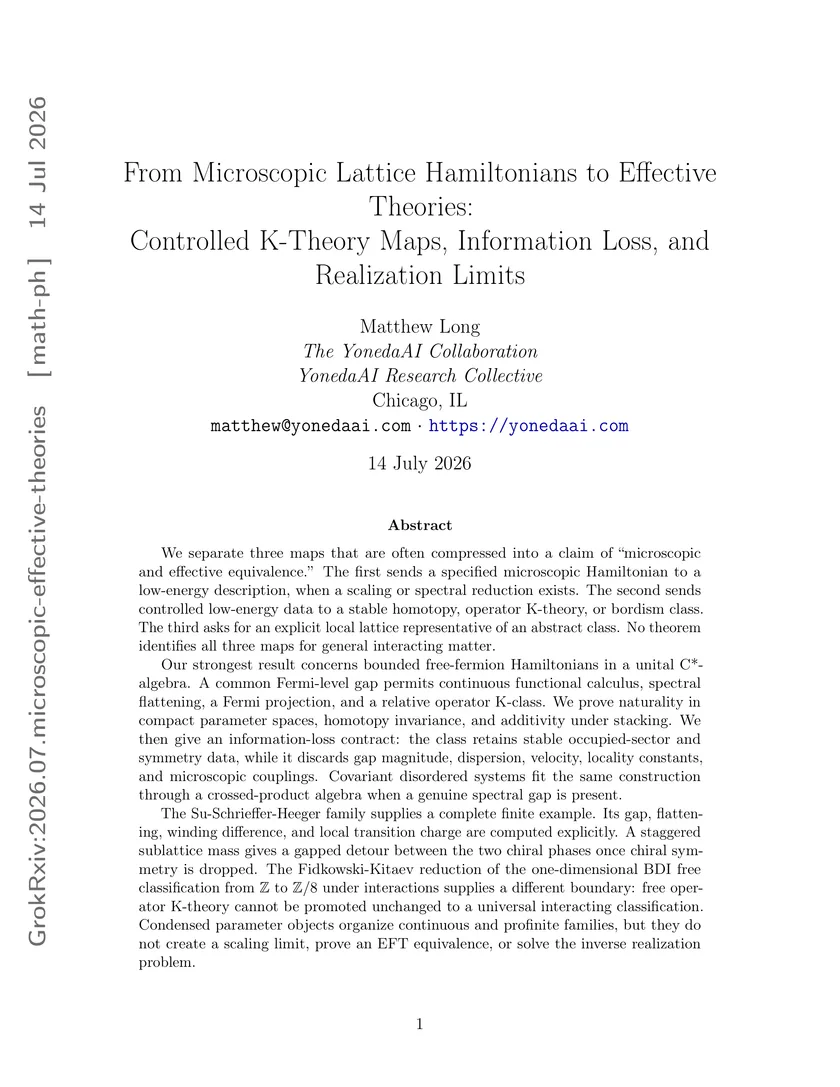
Three maps, not one equivalence
Functional calculus gives a controlled free-fermion map to K-theory, while scaling, classification, and inverse realization remain distinct.
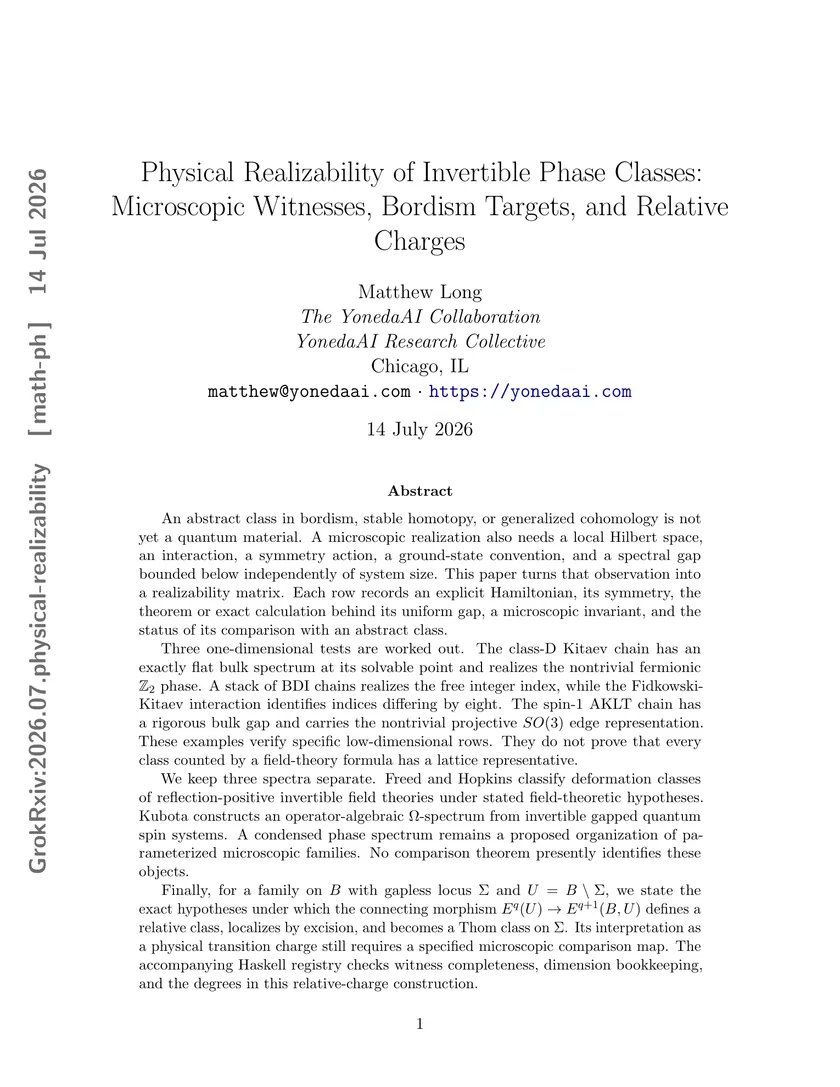
From abstract class to lattice witness
Kitaev, BDI, and AKLT models verify concrete low-dimensional rows without claiming every bordism or homotopy class is realizable.
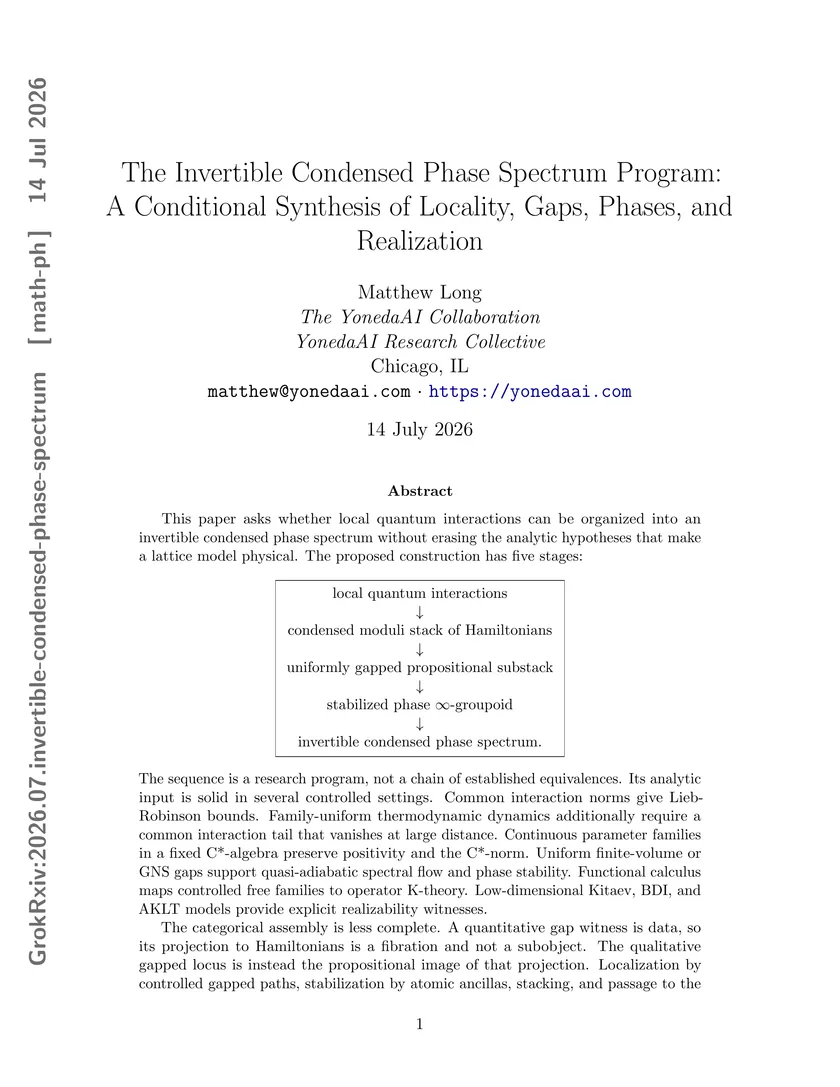
Conditional assembly and claim-status ledger
The synthesis keeps the five-stage program precise: solid analytic inputs, conditional categorical assembly, and no unproved spectrum comparison.
Executable research record
Finite witnesses and contract checks that reject known false inferences.
Library interfaces that formalize the program without overstating results.
AGY paper review and independent Claude code review for each paper.